AI on the phone: what it costs, what it must say and what it may record
In our example built from vendor list prices, a minute of conversation with an AI phone assistant costs about 4 to 11 US cents. Packaged subscription products range from 50 to several hundred euros a month. Since 2 August 2026 the assistant must say in its first sentence that an AI is speaking. And in Germany, recording audio without consent is a criminal offence, so a transcript without stored audio is the safer route.
Most pages on AI phone assistant costs are vendor-written top-ten lists. This article breaks the minute into its components, sets out the duties under the AI Act, the German Criminal Code and the GDPR, and compares the ways to run an assistant.
What a minute costs
An AI phone assistant is made of components billed per minute: telephony, speech recognition, the language model that writes the answer, speech output and, on managed platforms, a platform fee. Vendors publish their prices, so a minute can be added up.
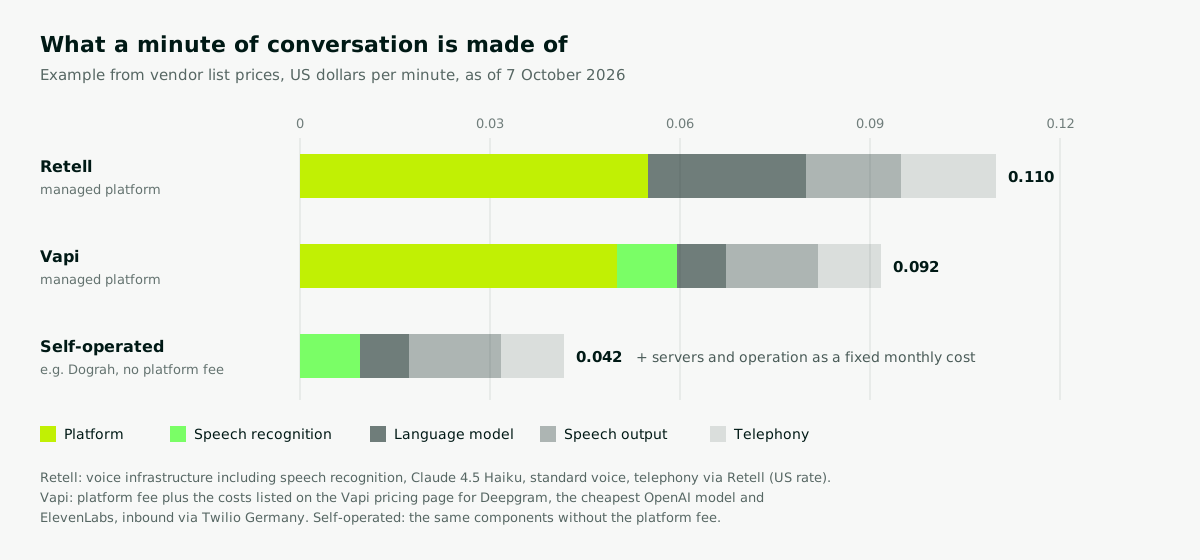
The figures come from the vendors' pricing pages (as of 7 October 2026, vendor statements):
| Component | Example | List price per minute |
|---|---|---|
| Platform | Vapi / Retell | $0.05 / $0.055 |
| Speech recognition | Deepgram Nova-3 multilingual | about $0.006 to $0.01 |
| Language model | small to large model, per Retell | $0.0016 to $0.16 |
| Speech output | standard voice to ElevenLabs v3 | $0.015 to $0.10 |
| Telephony | Twilio Germany inbound | $0.01 |
The range is wide because the model and the voice drive the price. A large language model and a very natural voice can double or triple the cost of a minute. For appointment questions and damage reports a small model is often enough; for open-ended advice it is not.
A worked example
Assume a property manager takes 1,500 calls a month averaging 2.5 minutes. That is 3,750 minutes. With the values from the chart, the minutes cost:
- about 345 US dollars a month on a managed platform such as Vapi,
- about 158 US dollars self-operated without a platform fee, plus servers and operation.
Compare packaged products with monthly bundles. fonio lists 299 euros for 3,600 minutes and 15 euros per additional 100 minutes, so about 330 euros. Telify lists 449 euros for 600 minutes and 0.59 euros per additional minute, which would come to about 2,300 euros. For property management there are offers from 50 euros a month. A bundle price is only as good as your assumption about minutes.
What the assistant must say
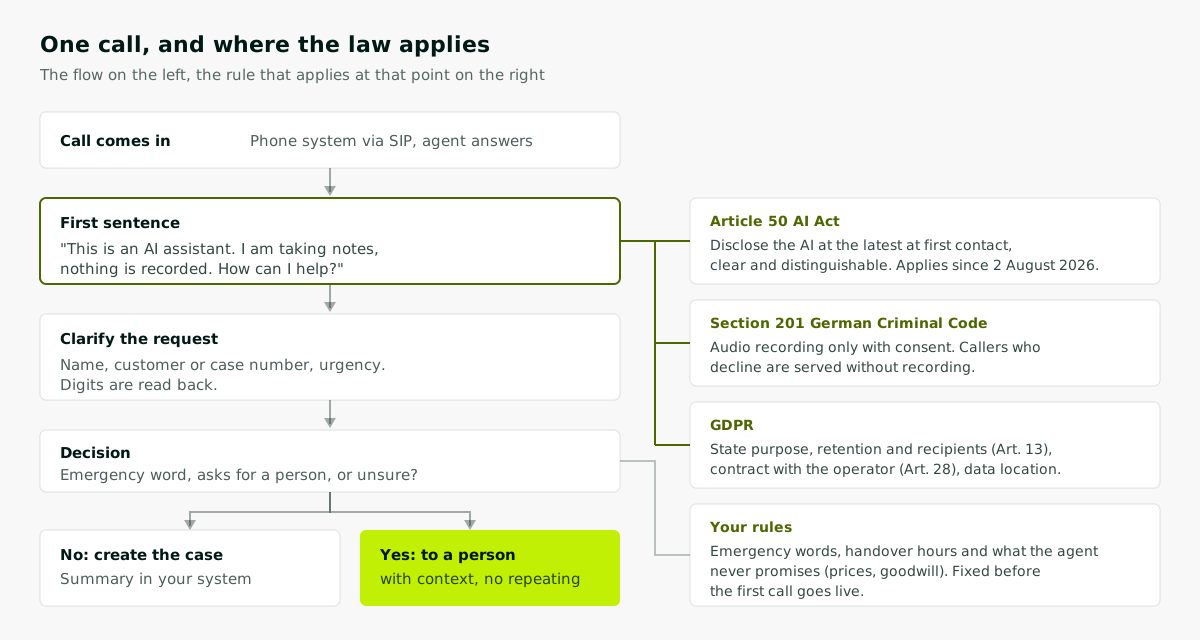
Since 2 August 2026, Article 50 of the AI Act applies. Under paragraph 1, AI systems that interact directly with people must be designed so that people are informed they are interacting with an AI, unless that is obvious. Under paragraph 5, this information must be given "in a clear and distinguishable manner at the latest at the time of the first interaction".
The Digital Omnibus, Regulation (EU) 2026/1744, did not move this date. A transition period until 2 December 2026 applies only to marking generated content under paragraph 2, not to the disclosure in a conversation.
The Commission's guidelines on Article 50 of 20 July 2026 get specific about the phone: an explicit spoken statement at the start, repeated in longer calls where appropriate. A tone or earcon on its own is not enough. And the more human the voice sounds, the harder it is to argue the AI was "obvious".
Who has to make sure of this? The duty in paragraph 1 falls on the provider, meaning whoever develops the system and puts it into service under their own name. If a property manager buys a finished product and uses it unchanged, it is a deployer and the duty lies with the vendor. It should still check the greeting, because its name is in the first sentence. If the assistant is built for you and run under your name, you may be the provider yourself. Clarify that before go-live. Breaches of Article 50 can be fined under Article 99(4) with up to 15 million euros or 3 percent of worldwide annual turnover; for SMEs the lower amount applies.
What it may record
Two laws apply here, and they are often confused.
Criminal law. Under section 201 of the German Criminal Code (StGB), anyone who without authorisation records another person's privately spoken words on a sound carrier faces up to three years in prison or a fine. A customer call is private in this sense. Audio recording therefore needs the caller's consent. It is open whether a live transcript, where the audio is processed only transiently and not stored, already counts as a "recording". There is no ruling on it. Our advice: do not store audio unless you need it, and store it only after an explicit yes.
Data protection. The German data protection authorities resolved in 2018 that call recordings are generally permitted only with consent, and that "press 1 if you object" is not valid consent. For handling the request itself, contract or legitimate interest usually suffices (Article 6(1)(b) or (f) GDPR). In addition:
- Information under Article 13: briefly in the call, in full in the privacy notice, with purpose, retention period and recipients. A generic "for quality purposes" is not enough.
- Contract under Article 28: with the operator and with every subprocessor in the chain: telephony, speech recognition, language model, speech output, hosting.
- Retention: transcripts are personal data. The period is fixed before the first call, not afterwards.
Where the data lives
A call passes through up to five services. For each, the question is where it processes data. The large platforms differ a lot here (vendor statements):
- Retell says it does not currently operate services in the EU and handles the GDPR through standard contractual clauses.
- Vapi offers a separate EU region. Whether the connected model and voice providers also process in the EU depends on their configuration.
- ElevenLabs offers EU data residency on its Enterprise plan.
Transfers to the US usually rely on the EU-US Data Privacy Framework. The EU General Court dismissed the challenge to it in September 2025; the appeal to the Court of Justice is pending. If you want to be safe, keep calls and transcripts in the EU, ideally in Germany.
Four ways to run an AI phone line
| Option | Cost | Data location | Fits when |
|---|---|---|---|
| Open platform you operate, e.g. Dograh | Minutes without platform fee, plus operation | your choice, including Germany | calls should not sit on a US platform |
| Managed platform: Vapi, Retell | Per-minute price plus platform fee | per vendor, EU sometimes at extra cost | speed matters and data location is settled |
| Voicebot module of your contact centre suite | Vendor licence | same as the existing suite | routing and queues already run there |
| Classic phone menu (IVR) | often included in the phone system | in the phone system | all you need is routing |
Dograh is open source under a BSD licence and describes itself as an open alternative to Vapi and Retell. We run it for our clients in German data centres and choose speech recognition, model and voice per case, with models preferably from EU endpoints. The price: someone has to run it, and the quality of the German voice depends on the chosen model. A packaged subscription can be the right choice if you have few calls and need no integration with your software.
Example: property management
In property management, calls are predictable: damage reports, questions about the service charge statement, keys, appointments with contractors. Three things decide the value. The assistant creates the case in the property management software instead of sending an email. Emergency words such as water, gas or heating failure are put straight through to the on-call team. And tenants often mention neighbours' names and details, which the retention period must take into account. The tenant phone assistant shows how that works.
Before go-live
Your next step
Count your calls by topic for four weeks. That gives you the minutes and shows which requests an assistant can handle and which need a person. Whether Article 50 and other AI Act duties apply to you, our free EU AI Act check shows. How we build and run phone assistants is described on the AI phone assistants page.
As of 7 October 2026. Prices are vendor list prices excluding tax and may change. This article is not legal advice.